

Conn Director 16 Student Clarinet
Repaired and Reviewed in 2023 by Jared Burchfield
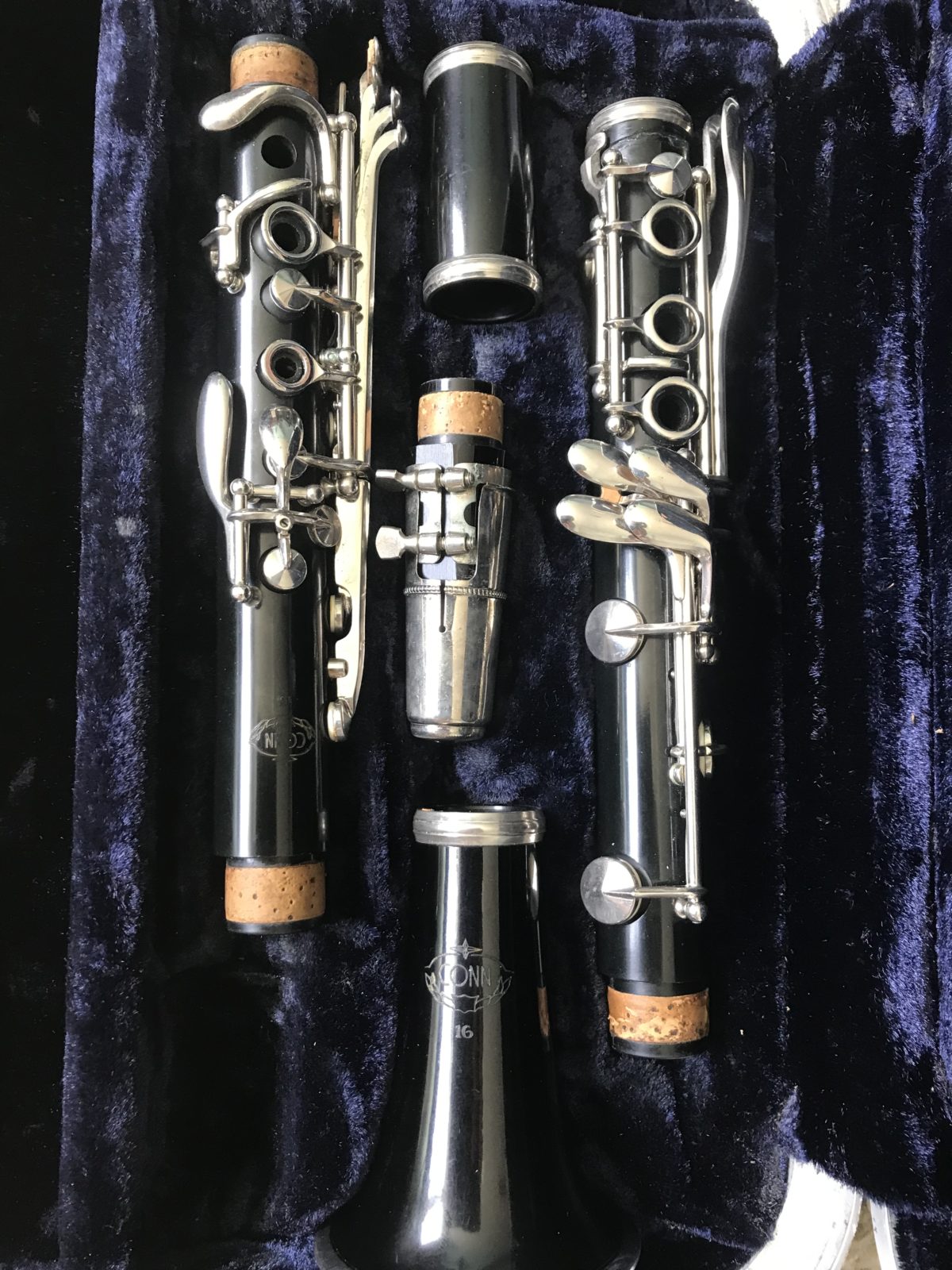
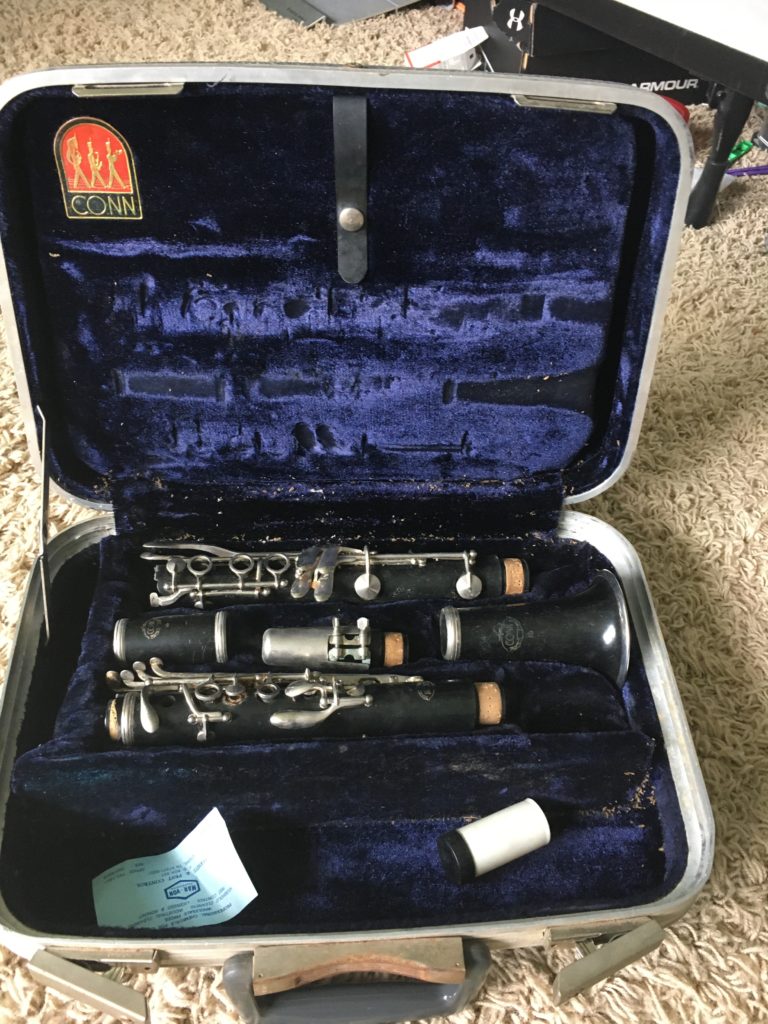
Introduction: I got this clarinet for free from someone who was going to throw it in the trash, and they had a good reason to do so. As you can see in the top left picture, the clarinet was disgusting and the center tenon on the lower joint had stepped completely off the joint. I was not told how this happened as the previous owner didn’t know, but I suspect is that it was stepped on during marching band or some kind of accident along those lines. In addition to that damage, it had no pads and was covered in dirt and dust, and the original case smelled strongly of mildew. It came to me with the case, a molded beginning band book which I discarded, the original but chipped Conn Precision mouthpiece and metal ligature combo, and some vintage reeds which were promptly discarded.
Because it was destined for the garbage anyway, I thought I would attempt to fix it. I really had nothing to loose, and I could potentially use it for parts if i ended up damaging it further. I started by gluing the broken tenon back on with Loctite Super Glue, and though I am well aware that this is not the proper way to do such a repair it actually worked and saved a clarinet which would have been trashed otherwise. After this, a set of pads and a good cleaning got this horn playing again and I am happy to have saved it from the trash it would have almost certainly gone into had it been taken to any normal repair technician.
General Info: The Conn 16 is a plastic student model clarinet made by Conn in the 1960s as their resin competitor to the Bundy and Vito clarinets. It was primarily marketed towards the school band instrument market for use by beginners and in marching bands. Some sources suggest that this could be a stencil, but I have not really found any concrete information to back this up as there is little information on the Conn 16, other then apparently the fact that jazz clarinetist Kenny Davern played one on his album “Smiles,” or so the album credits suggest which is where I got this information. The Conn 16 is no longer manufactured and the Conn name is now owned by Conn-Selmer and is mostly used on brass instruments.
Playability and Tuning: Having never owned a Conn clarinet before, I was excited to give this instrument a play test. With my Vandoren BD5 13, I found that it had a nice full tone at higher volumes but could get a bit sharp and airy at soft dynamics, especially in the throat tones and most of the chalameau register. Though the tone was big and full, it was pretty average in its responsiveness. It wasn’t terrible, but it was noticeably less responsive its competitors at the time such as the Bundy and Vito. The sound was a lot more centered and quite a bit darker when compared to some of the other student horns I own, and it was a lot harder to spread on this clarinet when playing loud which I liked a lot which was true throughout the lower and upper registers. There were a couple of stuffy notes, particularly low c#, some of the side keys such as eb, and oddly enough low G was a bit stuffy which I have never encountered before. Intonation is kind of interesting with this horn, as it tends to play a sharp in the lower register at lower volumes especially, but with the right mouthpiece and some awareness it would be fine. The horn plays well in tune in the clarion for the most part except for the clarion C and long B and the lowest E and F, all of which are flat to the point of being pretty noticeable even when playing on your own, which I thought was kind of odd. After some experimentation I found that the reason for this seemed to be that the bell is actually a bit too long for this clarinet or something like, as putting a shorter bell from another clarinet on the Conn brought those notes in tune. A very strange issue to have, especially with the bell that came with the instrument from the factory. This oddity was only really noticeable at louder dynamics, as playing softer brought all of these notes right in tune.
Construction and Build Quality: The plastic resin body of this clarinet is very hefty and the instrument is pretty heavy when compared to other student horns, especially newer ones such as the Yamaha YCL-255 and the Vito I reviewed elsewhere on this site. Everyone who has held this instrument has commented on how heavy it is. The bell also flares out a lot and bell is very large as compared to my Bundy and Vito horns. It also features the bell ring which is cosmetically pleasing to see, and I really like how Conn put their logo on every joint of this horn except the lower joint. Some might think it is unnecessary to do this, but I always liked it when manufacturers did this with logos. Overall, the horn’s body seems to be constructed well and seems like it could take a good beating, unless it is directly stepped on in marching band or something like that. It must have had one heck of an accident to break a body this hefty. Maybe the center tenon is just a weak area? The keywork is nicely constructed, and it feels great in my small hands. The keywork placement is very comfortable and the action is pretty good, and you can tell Conn intended for students with smaller hands to play on this instrument. My only issue with the keywork are the in line side trill keys. They are positioned in such a way that the throat Bb trill key actually bumps into and opens the key above it, which effectively makes it useless. It is almost like Conn didn’t really intend for these keys to be used. It is possible that it could be off adjustment wise, but I can’t really see a way that this could be made any different which puzzled me. I have since adjusted this some, and while it is now usable the trill keys still come far too close to hitting for my own comfort. The Eb trill key is similar in that it bumps into the bridge key below it, making a loud clicking any time you use it. The keywork feels well made, but there are some odd and nonstandard designs here that just don’t make a lot of sense.
Case: This clarinet came with the original case and though this case has seen better days, its design is just so cool. It is your typical decorative 1960s looking case with several eye catching logos and lots of color which I really like. It is also huge, as there is a ton of space for storing just about anything you can think of as far as accessories go. This case also has a flap that folds down inside where you can actually put books and music in the case. Now that is an innovative case design. Why did we move away from this? As far as holding the instrument goes, the instrument fits securely and it stays still and in place while transporting which I cannot say for other student clarinet cases, so that is a point in their favor. The only negative comments I will make about this case are the latches. They are kind of awkward to use, and they have so much tension that they can and have popped back when you are not expecting it. I actually had my fingers get caught in these things when I first got it. Also, this case is kind of weird to open as there is no good way to grab the lid and open the case after undoing the latches. Overall, the case is a pass for its innovation and functional design though there are some oddities about the latch design in particular.
Conclusion: The Conn 16 is a solid student horn that would be pretty good for a beginner or a casual player, and I will say that I have even played this clarinet on some more casual gigs and had good luck with it. It has a nice sound and good intonation generally, hefty construction and a solid case design overall that protects the horn. The keywork has some strange designs, but overall its quite solid and I prefer its layout with the larger touch pieces to some of my other horns. I see so many people on online forums bashing these horns for terrible intonation and bad tone and all of this other stuff, but that has not been my experience with this thing at all. Of course it has some issues like all clarinets and the bell thing is kind of strange, but I think it gets a nice tone and I would even say tuning on this Conn is better than some of my other student horns especially when the upper clarion is concerned.
Would I recommend a kid to start on this clarinet? Sure, this horn would be a solid starter horn for a beginner provided that you found it in good shape at the right price, and would certainly fare better than the generic Amazon clarinets and things of the like. Honestly, I think it might have a slightly bigger and darker tone then some other student horns that it competed with, which is a plus for all of the folks that love a dark sound. Though I don’t play it like I used to, I use this horn as a backup horn for gigs and recordings, and it sometimes gets out during my personal practice too. I don’t plan to ever get rid of this horn as it isn’t worth much, it is kind of sentimental given where it came from, and it is nice to have a beater horn to take to those places like band rooms and just about anywhere else where your expensive stuff might get damaged. This horn is a true restoration success and stands as a testament my belief that no horn is lost and that anything can be fixed and made useful again.