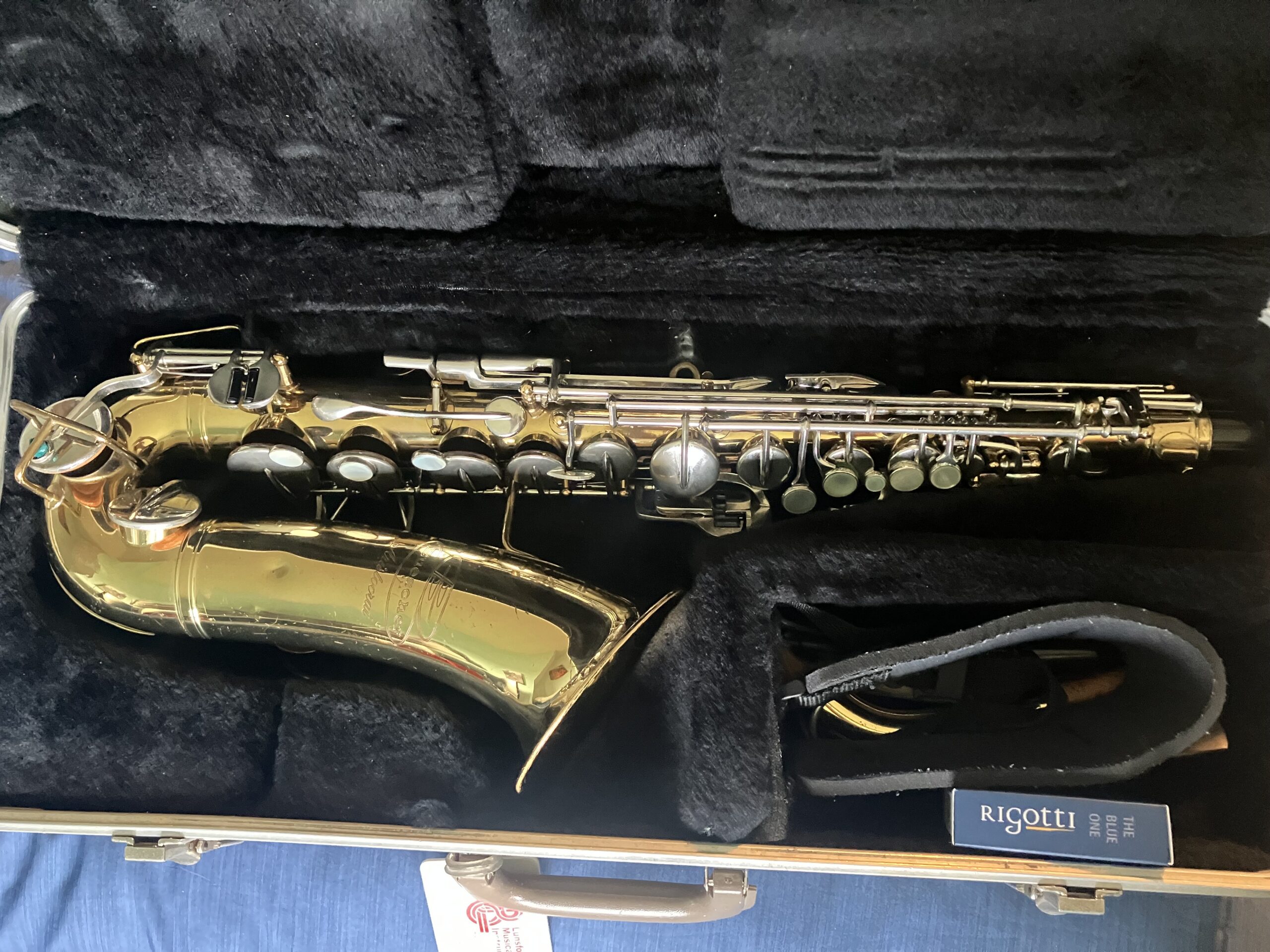
Buescher Aristocrat Alto Saxophone
Reviewed in 2025 by Jared Burchfield
Introduction- After being dissatisfied with my King Cleveland 613 alto sax because of its noisy key work and intonation issues, I found myself searching for another alto saxophone. Though I had tried and owned a couple of more modern alto saxophones including a very solid older Yamaha YAS-23, I still wanted to find a nice vintage alto saxophone with the older key work style. One day I came across the pictured alto saxophone above for $120 at a local pawn shop. While looking at it, the salesmen told me the horn had been in the shop a while and he told me they could sell it to me for $60, and I couldn’t get my credit card out fast enough. After dealing with a stuck rod and some octave key adjustment issues, the saxophone was fully playable with its likely original and well worn pads, and I got my money back out of this saxophone on the first gig I played with it.
General Information- This Buescher Aristocrat was likely made in the late 1960s-1970s after Selmer USA bought out the former Buescher Band Instrument Company, a well known maker of both student, intermediate, and professional saxophones through the first half of the 20th century. During this time, Selmer USA reportedly used some of Buescher’s designs as the basis for their Bundy line of student model saxophones. There is much debate online about how exactly the instruments are related, and though it seems that no one can come to a definitive conclusion on this, many sources seem to agree that saxophones from this time branded Buescher Aristocrat and Bundy are the same instrument minus their branding and are distantly related to the older Buescher Aristocrat professional saxophones. Thus my comments in this review will apply to both the Buescher and Bundy branded versions of this instrument.
Playability and Tuning- After playing the incredibly bright King Cleveland 613, I was pleased with the Buescher’s darker and more controlled sound. The tone was pretty consistent across all registers, with the lower register being excellent with a huge full sound all the way down to the low Bb. The upper register continues this dark tone and is also quite good, although the higher A with octave key can be a little bit stuffy and sharp and this note really stuck out among the otherwise consistent upper register. I find that most notes above the high A with octave key can be a little thin and don’t project as well as some other saxophones I have played, but it is manageable with some practice. Tuning is pretty good as well, with the only standouts being a rather flat middle C without octave key, a slightly flat G# both with and without the octave key, a middle D and E with octave key that trend sharp typical of many alto saxophones, and the previously mentioned high A with octave key. Other than this, the Buescher plays pretty well in tune with the few tendencies it has are manageable with a good mouthpiece and some practice. Overall, I really like the tone the saxophone produces, as it is big but still dark but with a jazz mouthpiece such as my Jody Jazz HR it can get pretty bright and project as well. Though this saxophone uses the typical vintage key work design with the bell keys on the opposite side of the bell, I feel that the key work this alto sax is much more responsive and functional as compared to the King I had played on. The Buescher keywork is certainly much quieter too which is hilarious given the King had been fully overhauled and the Buescher had not. I did have to unstick some of the many rollers on the left pinkie keys on this alto which seems to be a common issue with these vintage alto saxes that I have encountered, but after doing that everything seemed to work well. The only complaint about keywork that I really have is the awkward placement of the alternate F# key. In addition to having to reach almost comically over to it from the low D pearl, the tone hole it covers is very small and in my opinion the F# it produces sounds stuffy and out of tune. Other than those small points though, I have no other major complaints. Sure, parts of this older key system such as the left pinkie keys are ergonomically a little strange, but that is nothing you can’t get used to with some practice. After discovering and playing on this old keywork design for a while, I have come to prefer it for its simplicity and durability.
Construction and Build Quality- The Buescher Aristocrat has a typical lacquered finish and nickel plated key work as well as what I think is a really neat looking logo on the bell. Though it lacks any kind of elaborate engraving, something about the shiny lacquer and the stamped logo on the bell looks nice and clean to me. The plating and the lacquer still look very nice after all of these years, and the dents and scuffs on the body of this horn seem to suggest that it was well used. The large collection of scratches around the neck strap hook on the back of the horn also indicate that this horn was most likely someone’s marching instrument as well, yet in spite of this the instrument still looks and plays fine. I have always loved the looks of vintage saxophones, and I have always liked the designs of these Bueschers in particular. The key guard design on the bell is simple but still quite elegant, and is a whole lot easier to work with from a repair perspective in my opinion. I like that the solid metal key guards on the low C and Eb keys are soldered on rather then screwed on like most modern saxophones. Though this was likely done as a cost cutting measure, it also seems to makes sense from a durability standpoint given the market the instrument was aimed at. With this design, you do not have to worry about small screws backing out and getting lost, nor do you have to worry about the key guards falling off. The key work is also solidly constructed and seems to be built with durability in mind. The rods and larger keys do not bend or move around like some more modern cheap saxophones, and none of the keys are loose like so many on the King were. It seems that Selmer decided to use more full length rod screws rather than pivot screws on most of the keys which makes it feel a lot more solid overall. I also like that the side Bb key on this horn is a single piece rather then an often clacky bridge key like more modern saxophones, and truly the simplicity of this instrument in terms of keywork and body design is something I really admire about this horn. The same can be said for the low C# key, as it likewise is a single piece and has no bridge key like a more modern saxophone. Though saxophones with many features, alternate keys, elaborate engravings and removable bells are impressive and all, there is something almost more impressive and fascinating about instruments with no frills such as this Buescher, instead boasting simple designs that just work well and make sense. And like most old Selmer Bundy products I have owned and experienced, this horn shares the classic durability and reliability that these instruments are known for. In the almost 3 years I have owned this saxophone I have not had a single issue with the instrument and it always stays in adjustment well, which is especially impressive given that it has probably not been overhauled or had a proper service since it was built back in the late 1960s at the time of this review if I had to guess. And also like many Bundy products, the instrument was produced the same way for a very long time and spare parts are generally available, unless of course you are trying by chance to find a replacement neck for one in which case I have discovered that these practically don’t exist for some odd reason.
Case- The Buescher and Bundy saxophones from this time period used the same plastic molded case designs, with the Buescher cases being brown and the Bundy cases being a dark green. The case on this Buescher thankfully moved away from the annoying latches used on the clarinet cases, and instead uses two solid conventional style latches instead which still function as intended and hold the case firmly closed. The handle on the outside of the case is comfortable, and the inside of the case holds the body of the saxophone firmly in place. My only major complaint about this case is that unlike most other saxophones I have owned, there is no molded out spot to place the mouthpiece or neck. Instead, they are thrown loosely in the open storage area next to the body inside the case. This seems like a odd and silly design choice to me, as the neck and mouthpiece could be easily damaged bouncing around freely in that storage area, and I never understood why this was done. There is more than enough space to make a spot to hold the neck and mouthpiece in place. Maybe it was a cost cutting measure? Other than that, I think the case for this horn is quite solid and functions pretty well for its age and what it is.
Conclusion- The Buescher Aristocrat is a beautiful looking and well made student saxophone that plays excellently and has a lot of character from its heritage. Though it is cost reduced, the instrument still plays very nicely for what it is and definitely captures the dark and full sound of vintage saxophones of the past. It has appeared numerous times in my recordings and at gigs all over the area. At one such gig, my college saxophone instructor remarked that he enjoyed the tone and intonation of my Buescher, and noted that I sounded much better on it more then I had on both my King or my Yamaha which is quite a complement to give to a vintage Selmer USA student horn. I have since overhauled this Buescher with brand new pads with metal resonators and continue to use it as my main alto sax of choice for gigs, practice and recording sessions.
Would I recommend this horn to a beginner? Absolutely. From the solid construction to the good intonation, these horns are a great budget option for a young player or even a casual musician if you can find one for a good price in playable condition. I would even argue that they are worth getting overhauled, as I am actually working on overhauling a couple of these that were deemed scrap by another shop for a band director friend of mine, after which they will be used in his band program as marching instruments. I do not feel bad about doing it either, because I fully believe that these Bueschers and their Bundy branded cousins will perform just as good if not better than their modern counterparts, and will certainly last longer than then new Chinese made saxophones flooding the student market and being pushed by so many shops today. So, if you see one of these for a good price at a local pawn shop, pick it up. You will not be disappointed.