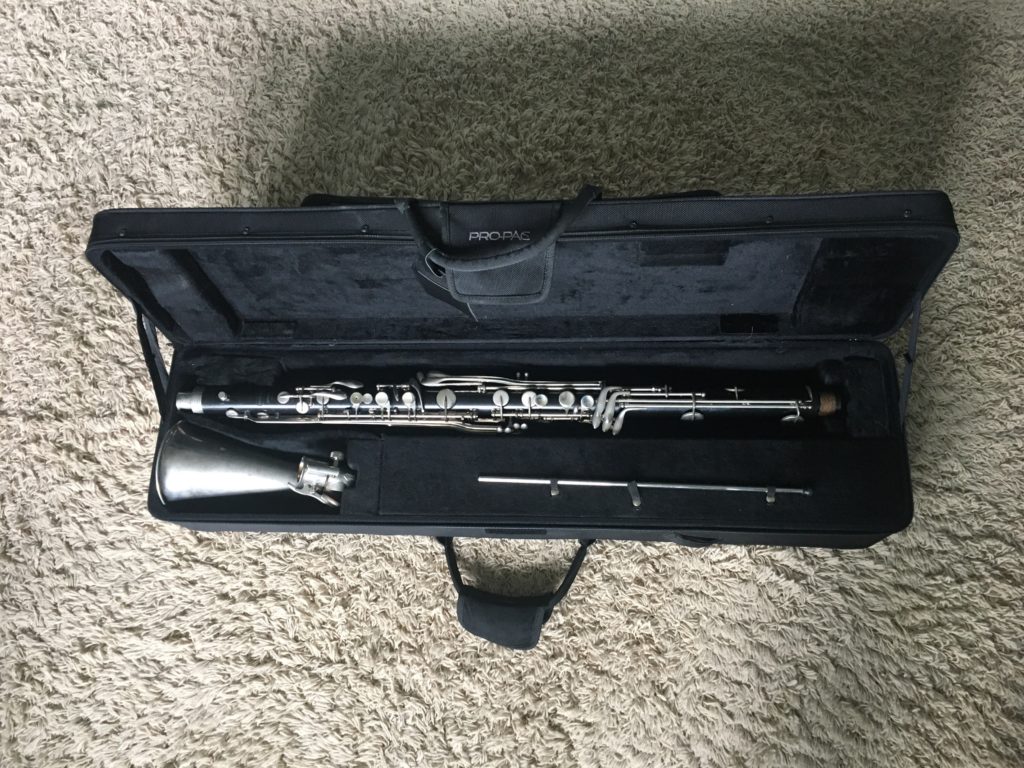
Selmer Bundy Plastic Bass Clarinet
Reviewed in 2024 by Jared Burchfield
Introduction: This bass clarinet was a graduation gift to me from my parents that we picked up for $850. While I have my doubts as to its claim that it was “professionally serviced” by the eBay seller, a few adjustments and pad replacements got most of the problems worked out. i was interested in a Bundy bass clarinet for two reasons, the first being that I had played Bundy bass clarinets in high school and had liked them for their playability and nostalgia, and also because they were and still are one of the most affordable but still solid used bass clarinets. This particular horn appears to be a later Bundy from the 1960s-1970s, as the later horns had their logos stamped on rather than painted (or whatever it was that Selmer put the logos on with that rubs off really easily, creating strange unbranded instruments that look like Selmers). Later horns from the late 60s to early 70s are marked with a large Bundy logo with a smaller Selmer logo, and USA all stamped below, while earlier ones from the late 50’s to early 60’s are marked “Selmer Bundy Resonite.” Later horns also use a plastic rocker on their register key mechanism rather than a metal one. This is all my guesses based on much online research and comparison to similarly marked Bb clarinets in archived Selmer USA catalogs. There is not much info or documentation like this out there on Bundy horns, and the bass clarinets seem to be even more obscure.
General Information: The Bundy 1430 bass clarinet is a plastic resin student model bass clarinet made by Selmer USA for their Bundy student between approximately 1950 and 1990 and possibly longer under the name Selmer USA or Selmer 1430P Step Up Model early on in the Conn-Selmer acquisition. It is important to note that this instrument is not the same as the current 1430LP though from Conn-Selmer. The Bundy name is no longer owned by Conn-Selmer and the Bundy bass clarinets are no longer manufactured. The current plastic bass clarinets manufactured by Conn-Selmer today such as the Selmer 1430LP, Leblanc L7168, Leblanc L60, and Vito 7168 are based on the design of the previous Vito Resotone bass clarinets built by Vito prior to the Conn-Selmer acquisition which take their design basis from Leblanc instruments, and have no relation to this older Bundy design which is very loosely based on Selmer Paris bass clarinets I believe. Again, if any of this info is incorrect please leave a me a comment.
Playability and Tuning: I have played a number of Bundy bass clarinets since I was in middle school, and this one is no exception to the others. This horn has a nice tone with tons of volume and bite in the low end, and I feel that it projects much better in the low register than other student bass clarinets such as the Vito models and even some pro horns too. The low end is also pretty responsive, though it can get a bit airy when playing softly. I have found this airiness to vary some depending on mouthpiece and reed combination and it gets better by doing some practice and long tones, but it is still there and more present than other bass clarinets I have played. The higher register is quite resistant especially when attacking quietly, and that is mostly because of the single vent “rocker style” register key which was created as a cheaper and simpler alternative for cheaper bass clarinets where a single tone hole is placed approximately between where the two holes on a double register key might be located on a higher end horn. While this may annoy some players, I don’t mind the resistance as it forces me to really think about my voicing and get used to its more resistant feel, after which the clarion register is quite usable and speaks pretty well particularly in the lower clarion area. The upper clarion and altissimo can be a bit abrasive sounding at times, and it takes quite a bit of work to get those to come out cleanly, but again that is nothing a bit of practice, a good mouthpiece, and long tones can’t fix. My Vandoren B45 certainly helps out with tone, especially when playing soft. Intonation is pretty decent and typical overall, with the worst spots being long B and C in the lower clarion being quite sharp and the low chalumeau Eb and E being very flat, all of which are pretty typical of most bass clarinets I have played. Really no huge tuning issue standouts here and the throat tones are pretty good too, though the A and G# trend sharp which is pretty typical. That single vent register key might not be ideal, but they sure make a nice throat Bb! Probably my biggest playability complaint is the tenor sax style “parallel neck” that comes with most of these Bundy bass clarinets. The angle kind of hurts your neck if you are not used to it, and the position at which the mouthpiece enters your mouth is not really ideal for a good bass clarinet embouchure, which sort makes finding a comfortable way to play this bass clarinet a challenge especially when sitting or using the floor peg. Really, I think the bottom line with the neck is it is something you have to experiment with and get used to, especially when you are coming from something that is more upturned like the Buffet Greenline I was borrowing from my college a while back. Not a total deal breaker, but something to make a note of and to practice with, and I kind of have a bit of sentiment for these necks as they are one of the things that give the Bundy its signature look. Not ideal, but certainly an icon of old school student bass clarinet manufacturing. It is possible to buy replacement necks for these bass clarinets that are much more angled, which makes playing them a lot more comfortable. I have since done this with my Bundy, and it is much improved both in comfort and tone quality. The later Selmer branded versions of these sometimes came with a sharper upturned neck, and a company called Charles Bay made replacement upturned necks for these bass clarinets years ago. Though rare and often expensive, we had these at my high school and they really improved these Bundy bass clarinets, which is saying something given how good the Bundy already is.
Construction and Build Quality: The body of this bass clarinet is a tough single piece plastic resin which seems to hold up to the usual abuse that these horns (mostly the ones I used in marching band in high school) have to endure, and have certainly I seen less of these split in half or severely damaged as compared to Vitos. The keywork action is a little loose lacking the precision that you might find on a Vito or a Yamaha and some keys such as the left pinkie keys are oddly placed when compared to other bass clarinets. That being said, the Bundy keywork is solidly built and seems to hold adjustment pretty well on both this horn and those I have played in the past. None of the longer rods on the lower part of the instrument bend or move like Vitos often do, and the keys are definitely made of a thicker metal then other student bass clarinets. The Bundy bass clarinet was definitely built for someone with big hands, which puzzles be a little given that this was made for students to learn on. It takes a bit of reaching to hit some of the pinkie keys, but once you get used to it the keys are pretty serviceable, especially if they are set up well. The nickel plate is mostly gone on this horn, but I attribute that more to its previous life as a school instrument rather than a quality issue on Selmer’s part. The best parts of these bass clarinets are certainly their durability, simplicity, and reliability. The single vent register key on mine has never went out of adjustment and rarely sticks, which is a common issue I have had with both Vito and Yamaha student bass clarinets, the single piece body alleviates the possibility of a misaligned bridge key occurring, and the plastic will never crack or warp like a wooden instrument will. And combining that with the number of these that were made exactly the same way for the better part of four decades and their popularity with school band programs, parts will almost always be out there for them if they ever do break. In short, these Bundy bass clarinets are like old Toyota vehicles: they take a beating and go on forever. I have seen these things getting used in every group from that hole in the wall high school no one has heard of to that big Band of America Championship band that clears out all of the class awards. And the crazy part is that many of these horns are over 40 years old and show no signs of stopping. I know mine certainly doesn’t.
Case: This horn didn’t come with an original Selmer case, and most of the ones we had in high school were so banged up that there is no way that I could do an accurate review on that. My only real comment on the original cases on these is that much like the Bundy Buescher Aristocrat alto sax case I reviewed elsewhere, the Bundy bass clarinet cases also have no place to hold the neck and mouthpiece in place. The case instead opts to give you a huge storage area where the mouthpiece and neck merely sit with no molded padding, and can move around freely while the case is being transported as a result. While I have never had anything get damaged while using one of these cases, it still seems like a bad idea and I really don’t understand why Selmer did this, other then it being cheaper to build. I will say that I have been very impressed with the Protec PRO PAC case that came with this horn though. It has plenty of space for storing instrument accessories and other items, and it holds the body of the horn still which is very important for keeping the horn in good shape during transport.
Conclusion: The Bundy is a solidly built and affordable bass clarinet for someone who just needs something simple to play on causal gigs or for their own practice. They are a bit finicky, especially if not set up right but I think we can all agree that this is true for many bass clarinets of both student and professional nature. With some practice, a proper setup, and a good mouthpiece, these can play really well and can accomplish a lot more then you might expect. I have often by choice played Bundy bass clarinets in marching band, jazz band, honor bands, all state bands, recording sessions, college auditions, college level ensembles, and I even plan to play mine on my upcoming masters recital. Because of its proven capabilities, the Bundy will likely continue to be my bass clarinet of choice for years to come as it is reliable, consistent, simplistic and plays much better than you would expect from a banged up old student horn. Whether you know them as a Bundy, a Selmer USA, a Buescher, an Artley, a King Tempo, or even a Boosey & Hawkes (Yes, Selmer actually made some bass clarinets for B&H at some point apparently), they are still all based on the same faithful design of the classic Bundy. Now I know the question you are asking: “Why on earth would anyone go out of their way to buy, setup, and review a Bundy? That’s just a crappy old student horn. No one really cares about anything but the pro stuff.” Most of the reason for me is sentimental, as this was the kind of bass clarinet I played through almost all of high school on, made all state on, and auditioned for college on. On a practical side of things though, I also really like the way these play and I think they have much more projection and a better lower register sound than any pro horn I have played, not to mention I admire their simplicity and durability and believe that these horns too should be documented and appreciated. Say what you will, but the Bundy does exactly what I need: A affordable but still good quality bass clarinet with all of the essentials that sounds good and looks somewhat retro in my opinion. And I would say that’s all one can ask for. Long live the immortal Bundy!