

Selmer Bundy Resonite Student Bb Clarinet
Reviewed in 2025 by Jared Burchfield
Introduction: Whether you love them or hate them, every clarinetist has heard of the infamous Bundy clarinet. Even if you didn’t start on one yourself like so many did (and still do), you are bound to have encountered one somewhere. Maybe it belonged to a student of yours or a friend, a school program, to a family member who was in band in high school some years ago, or perhaps you own one that was yours when you were in school band. Regardless of the situation, we are all familiar with the Bundy clarinets. This review is going to be both a review of the specific instrument in the photos above and just the Bundy clarinet in general as I have owned and played many of these and most of my comments apply across the board.
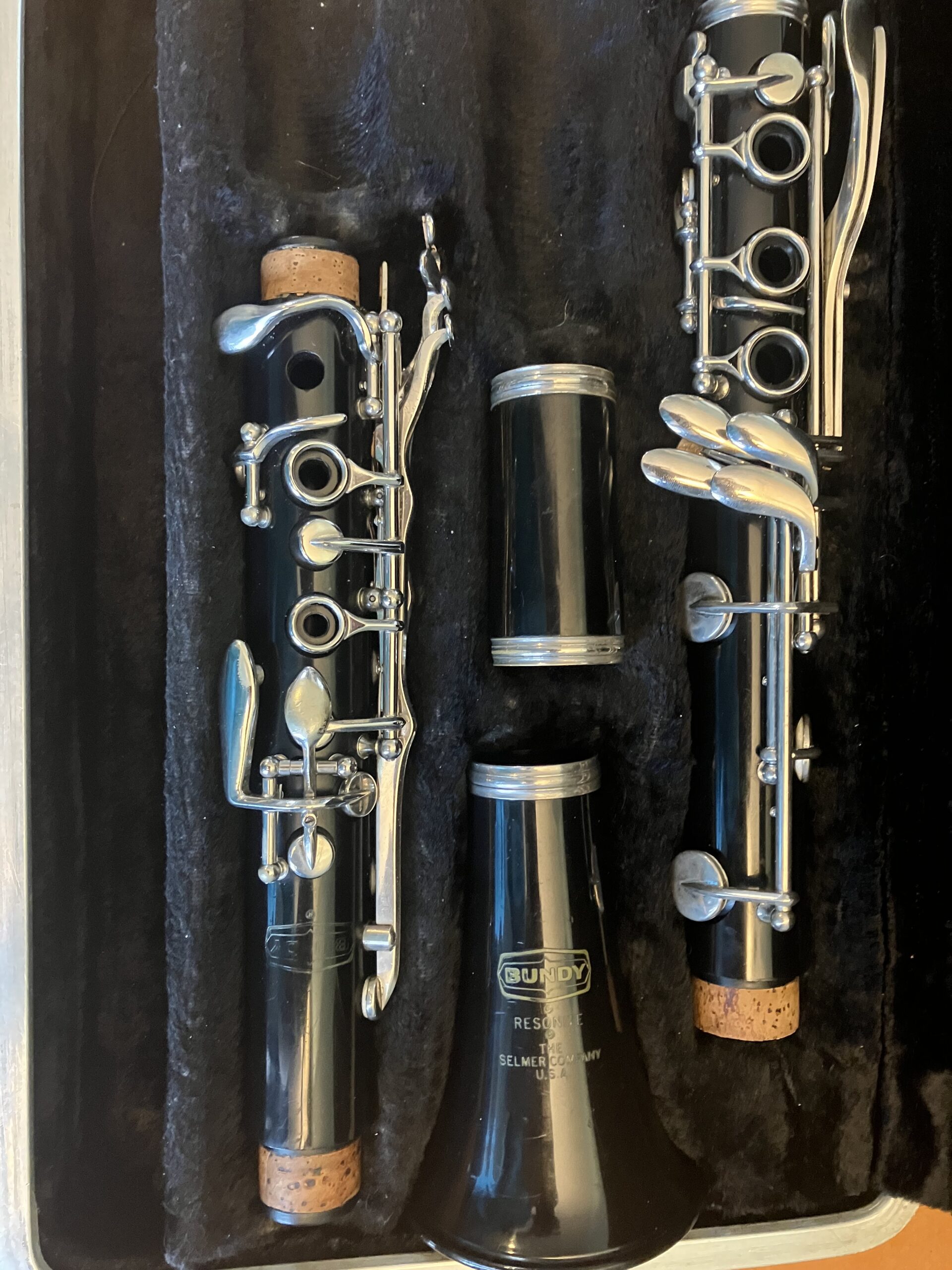
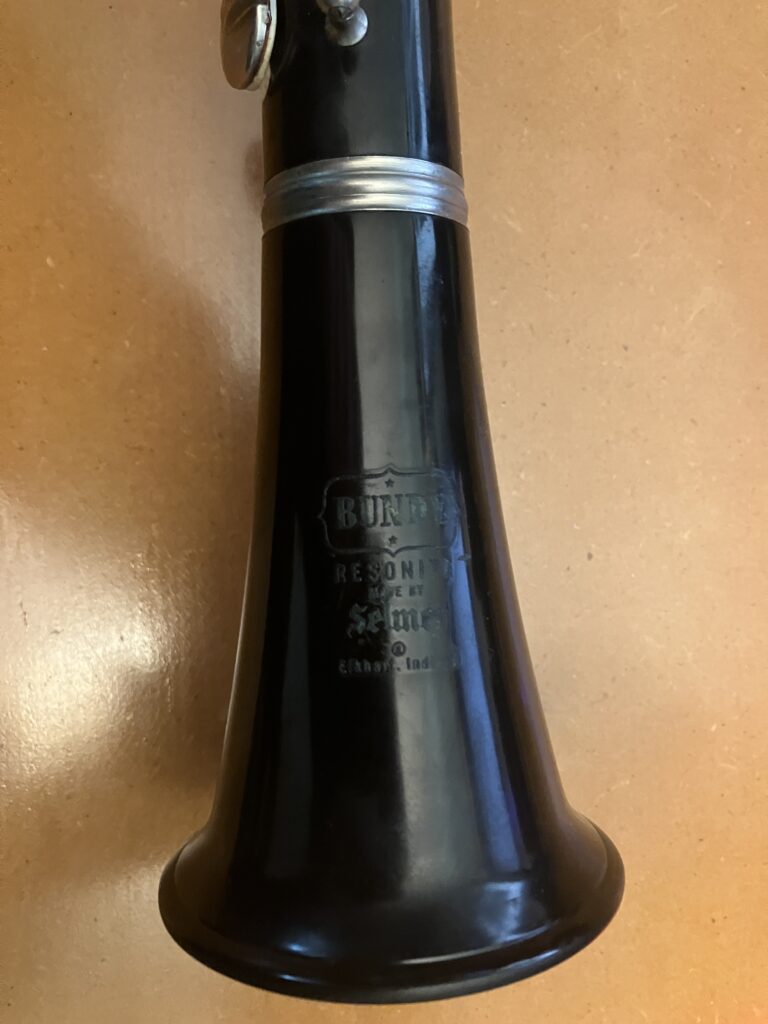
There are two clarinets pictured in the photos above. The top row features a soon to be restored Bundy clarinet from the earlier generation of these horns complete with the original Geo. M. Bundy 3 mouthpiece, with this example likely made in the 1960s. I got it on eBay as a part of a listing with another more expensive instrument which will probably be reviewed soon. The bottom row is a Bundy from approximately the 1970s-1980s which I picked up at a massive antique store in Pigeon Forge, TN for just $50. As you can see in the photos, it is in remarkably good shape minus some damage to the bell tenon which still works fine and a bit of plating wear on some of the keys. I really liked that the logo on the bell was so nicely preserved and that the case was so clean and the latches actually worked correctly.
General Information: The Selmer Bundy Resonite or the Bundy 1400 clarinet is widely considered to be the first successful plastic resin clarinet, first being introduced by Selmer USA in the late 1940s and early 1950s. The line ran from that time until the early 1990s until the name was discontinued. The design went on to be used on the Selmer 1400 clarinets into the Conn-Selmer merger. The design and bore are reportedly based on some model of Henri Selmer Paris clarinet, although I have not been able to find what specific models it is based on. Through their entire production run, the design of these clarinets changed very little with only small changes to the keywork and logos, which you can see in the above photos. The cases changed quite a bit over the years, and I have often seen the case design used as a way to date these instruments, as the designs of horns themselves give little clue of their era save for the very early ones which look a bit different. The Bundy clarinet is a horn of many names, and if you have ever played an old plastic clarinet branded Selmer USA, Buescher, King Tempo, Bundy 577, or a plastic or wooden Selmer Signet, you have played an instrument that is heavily based on a Bundy, and I am probably missing some other associated brand names. The Bundy name is no longer owned by Conn-Selmer, and for a short time the name was owned by a Chinese company that is stamping the brand on generic instruments which as far as I understand are equivalent to low priced CSOs on Amazon and are not the focus of this review. As of 2025, no new clarinets are being produced under the Bundy name. Though there were several examples of wooden Bundy clarinets made as well, this review covers plastic Bundy clarinets made by Selmer USA from about 1950-1990.
Playability and Tuning: There are those out there who say that Bundy clarinets are terrible, but honestly that has not been my experience. In fact, my experience playing Bundy clarinets both as a high school student when I first discovered them, and as a current masters student in clarinet performance has been and continues to be quite good, especially where the earlier ones are concerned. The tone is clear and full, and there aren’t really any abnormally stuffy notes to speak of other than the throat Bb which can be pretty stuffy, but thankfully it is in tune at least. Bundy clarinets can be a bit on the bright side as far as tone goes and are often what I like to call a “screamer” for their huge sound and the fact that you can just keep pushing them and they just keep taking what you are giving them. But with the right mouthpiece, reed strength and some practice you can get quite a nice round tone from them too. I took this to a bit of an absurd level one time during a blind experiment in which I was able to convince my clarinet instructor who has a doctorate in performance from Indiana University that I was playing a wooden clarinet while playing one of these. She commented on the great tone and control of intervals from this supposed wooden horn, when in reality I was just playing an old plastic Bundy. Even I was surprised to hear her say this. Who would have thought? As said before, I also like that these horns can really project volume wise and can handle the player pushing at high dynamic levels without going out of control. That being said, it is quite easy to spread if you are not careful, especially in the low register and the altissimo which can become quite shrill at times. As far as tuning goes, nothing really stands out compared to other clarinets of both student and professional nature that I have played on. Most everything is either right on or just a few cents off which I can easily adjust. The Low E, F, and F# as well as throat tone E and side Eb can run a little flat as well as the lower chalameau B, Bb and A being rather sharp, but I have found this to also be true on many other clarinets, and it is nothing that I cannot work with. Other than that, everything plays pretty well in tune to my ear and my tuner, even in the upper extremes of the horn which I find hilarious considering that I have been told that “you can’t play in tune on a Bundy” by many a teacher both in high school and college, only to have little to no issue doing so on my examples. As I have matured as a clarinetist and become more aware of different aspects of different instruments, some of my other student horns have fallen out of my favor. The Bundy never has though, and truly I can’t fault these horns: they play evenly throughout all registers, they are responsive and not really stuffy, they make a good tone, they play in tune pretty well, and they are extremely durable.
Construction and Build Quality: Bundy clarinets are constructed of a tough plastic resin, with nickel plated metal keys. The bodies seem thicker and more hefty than some other student horns of the era such as Vito ResoTone clarinets, but are still not as heavy as the Conn 16 I reviewed elsewhere on this site. I have noticed chips in the thin plastic around the bell tenon is something that can happen as two of the six (yes, six) Bundy horns I own have this damage, but maybe I just ended with two rough ones. It should be noted that this damage was only present on the later Bundy clarinets, but was not present on the earlier ones. Nickel plating seems to hold up very well on these across the as all of my Bundy horns look quite good for their age, only having large amounts of wear in commonly touched places such as the throat A and C# keys and the thumb F key as well. Though the keywork is a little soft and can be bent easily with a little force, it still feels well placed for my small hands and the action is actually quite good when set up well in my opinion.
Bundy clarinets in particular seem to have this almost ridiculous reputation for durability, reliability, and lasting forever even when in terrible condition among teachers, repair techs and players alike and I can say first hand that the reputation is well deserved. Though my time teaching and playing, I have seen these clarinets get dropped, thrown, stepped on and slammed into things, and almost every time they were picked up and played with little to no damage or adjustment needed. One personal experience that comes to my mind is a poor Bundy that was slammed in a band room fire door by a unsuspecting high school student hastily exiting a band director’s office after their playing test. The student let go of the horn and it toppled to the floor in the path of the closing door, which slammed hard on the upper joint. After realizing what happened, the student picked it up and of course it played perfectly, with only a little scratch on the upper joint to show for it. Had this been a pro horn or other cheap student horn, it would have surely needed an expensive trip to the shop, but not this old Bundy.
These things really can take a beating and seem to stay in adjustment pretty well. And being that they are plastic, they don’t crack or warp like wooden horns, which makes them a great choice for outdoor gigs or environments where a horn could be easily damaged like marching band or a school band room. These horns were meant to hold up to student abuse, and they largely seem to do that as the newest ones are nearly 40 years old and are still being use by band programs large and small all over the United States. They are without a doubt the most common vintage clarinet I see in service besides the Vitos, and even here in 2025 there are still many kids playing, renting and owning these horns. Aside from their durability, there were so many Bundy clarinets made the same way for so long that if one ever did break, spare parts would be readily available from a number of different sources. In short, they are simple, consistent and reliable workhorses that seem to stand the test of time, and if there is ever one horn in my collection that I can count on to play great in the face of great adversity, that would be the Bundy.
Case: I have owned several original Bundy cases in varying conditions and my opinions are kind of mixed. The designs of these are hilarious, and the colors on the brown ones and their bold yellow and green logos like the one pictured in the lower row of photos are probably the most 1970s looking things ever. The green ones are quite iconic as well, and the design language of these cases speaks heavily to their time period. They certainly stand out in a sea of generic black soft and plastic cases with tiny logos filling many of today’s band rooms, and give a bit of a retro flare to your clarinet if that is your thing. Everyone knows a Bundy case when they see one, and I really miss cool case designs on horns which I feel that companies don’t do anymore. Whatever happened to making your product stand out? The handles are among the most comfortable plastic handles I have used other than Yamaha’s case handles, and the inside of the case seems to hold the instrument fairly well. I do feel that it could be held a little bit tighter as some parts still feel a bit loose, particularly where the bell and barrel are concerned. It is odd that Bundy cases have space for two barrels in their cases, as I don’t know that I have ever seen a Bundy clarinet with two different length barrels (although I have seen these filled with two barrels from two different kinds of clarinets or even mouthpieces in school horns). There is little for storage inside the case other than a small trough like space for reeds and maybe a small cleaning cloth, and personally I would have taken a slightly bigger case with more storage if I had to choose. While the Bundy horns are made to last, the case latches are certainly not. These case latches have to be one of the worst designs I have ever seen and they seem to just pop open if you barely touch them the wrong way. They don’t feel secure, and they are strange looking and I feel that they have only worsened with age. It is all to common to find these cases out in the wild with one latch that will not stay closed. I do like the Bundy cases for their aesthetic elements, but the latches are a major problem, especially on the later brown cases.
Conclusion: Bundy clarinets are solid, well made clarinets that are great for a wide variety of purposes. Though I find the older Bundy clarinets with the older logos from the earlier generation be slightly better in feel and playability, the newer ones are by no means bad and can still perform at a much higher level then that which they were intended. They are an excellent and very affordable option for students starting out, and likely you won’t have to upgrade your horn for a long while. Heck, I am a masters student in clarinet and I play my Bundy clarinets in my own practice often, some gigs in cold or dry environments, some lessons on cold days, and even rehearsals sometimes and my teachers have never once complained, and why would they feel the need to? These horns play in tune, produce a nice sound with a good setup, and are built like tanks made to withstand just about anything you can throw at them. They also make a fine backup horn or outdoor gig instrument for a more seasoned player, and I done this many times and have known other players who have used them for these purposes as well. The Bundy horn is truly one of the unsung classics in band instrument history, and no matter what happens it seems as though you just cannot kill them. I said it in the bass clarinet review, and I will say it again: Long live the immortal Bundy!